
Outdated or Unsupported Browser Detected
DWD's website uses the latest technology. This makes our site faster and easier to use across all devices. Unfortunatley, your browser is out of date and is not supported. An update is not required, but it is strongly recommended to improve your browsing experience. To update Internet Explorer to Microsoft Edge visit their website.

Effective: April 2025
The following appendices contain resources, examples, and information that should be used throughout the self-employment process. Some of these appendices are referenced in the steps of the Supported Self-Employment Toolkit V2.0
The following items – in addition to any others not listed – should be discussed with the consumer regarding the advantages/ disadvantages of self-employment.
For the consumer:
Any advantages or disadvantages not listed above that are specific to you?
Do you have any experience with self-employment? If so, what did you learn from that experience?
Consumers receiving SSI and Medicaid should be aware that for Limited Liability Corporations (LLC), S Corporations, and C Corporations business assets may be considered personal assets.
Working with a work incentives benefits specialist will assist consumers in making an informed choice on pursuing self-employment. If a consumer decides to proceed with self-employment, it will help them understand how the Social Security Administration evaluates work activity, available employment supports, and how to structure their business.
Information regarding Social Security Work Incentives provide an opportunity for individuals on SSI/SSDI to work. Some individuals may be interested in creating a PASS Plan through Social Security.
Like the general population, people with disabilities face the same risks and liabilities when owning and operating a business. Successful business owners (regardless of ability) make it a practice to build a “technical assistance team” around themselves for support guidance and feedback. People with disabilities can rely on family members, human service professionals, rehabilitation professionals, and other community members to help them when planning to reduce the risk associated with starting a business.
For supported self-employment, a Business Planning Team should be developed. Most business planning teams have their “core members.” At minimum, these core members should include the potential business owner, important family members, a legal guardian, the DVR counselor, County/MCO Case Manager, and their vendors/service providers. These core team members usually meet every 4 to 6 weeks while developing the supported self-employment business plan, and on a quarterly basis once the business has been launched. Other important team members can have “cameo” appearances at team planning meetings. These team members might include a Benefits Specialist, Occupational Therapist, Assistive Technologist, direct support staff (job coaches or home supporters), friends, family members, experts/consultants, and other community members.
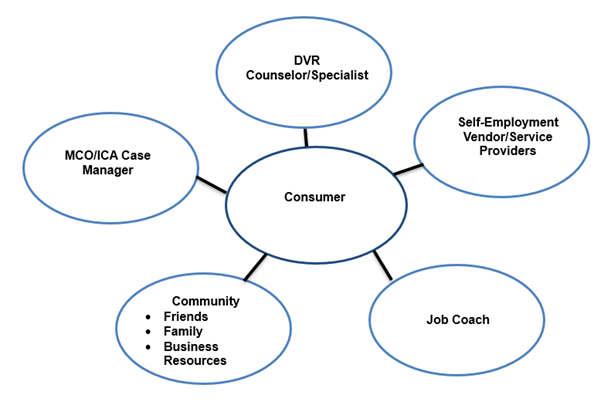
Although each person’s responsibility within each BP Team will have its uniqueness, there are some commonalities in their distinct roles within the planning process. The bullet points below represent a framework for team members to begin clarifying their part in the process.
This ERQ is designed to help the consumer think about and explain how their skills, abilities, and access to resources may lead them toward a successful self-employment outcome. The questionnaire will assess the consumers' management experience, industry/technical experience, personal credit and financial solvency, commitment/desire/persistence, and family/community support.
The ERQ should be completed by the business planning team along with the consumer. Once the ERQ is complete, it is reviewed by the local Business Assessment Scale (BAS) representative.
The BAS review should be conducted with the entire Business Planning Team and the consumer. The review will also include the self-employment lead and two statewide BAS raters.
Attach the following in IRIS, ensuring that personal and private information is redacted, and submit it to the Local BAS Representative:
If the Local BAS Representative determines the ERQ is not complete, work with the consumer to update the document. Note: If the consumer declines the opportunity to update the ERQ, notify the Local BAS Representative, so the process can move forward.
Review the BAS process with the consumer and give the consumer a copy of the BAS scoring tool.
Note: The consumer should not receive a copy of the BAS rating tool, and they should not score the BAS prior to the meeting.
Note: This is completed within five (5) business days of BAS Review:
Note: Individuals using this toolkit may require additional support in multiple areas of owning or operating their business. The business plan should include any additional support provided by the Business Planning Team. Each section that has additional support required should be clear about what support is being provided and who is providing the support.
Business Name, Consumer Name, Address, Phone, Email, Date.
The executive summary is the first and most important section of a business plan. Its purpose is to convince the audience that this business is worthwhile. This “opening argument” must capture and hold the intended reader’s attention and direct it to a specific purpose. The executive summary should avoid industrial jargon. Make the summary clear, concise, and convincing. Although the executive summary appears first in the plan, usually it is the last section written.
This section discusses the purpose of the business, form of ownership, ownership interest, industry trends, background information about the owners.
This section describes the product or service, the currently unsatisfied market needs or desires, and describes how the product or service will meet those needs / desires.
This section should also contain an estimate of the potential market, the number of customers the business expects to serve immediately after opening, the rate of expansion, and possible expansion into other markets.
The operations plan explains how the work will be done, how the business will be managed, and the business’s location. It describes the manufacturing process including materials used in the process and employees and their duties.
This section discusses the investment required, sources of funds for the business, and financial statements. Developing these financial statements is one of the most difficult tasks facing a new business owner, because in most cases there is no history for reference. Unless a consumer plans to purchase an existing business, these statements will be based on projections. Develop the Income Statement, Cash Flow Projections, and Balance Sheet statements for the first three years of business operation. First-year cash flow is projected monthly. Years 2 and 3 cash flow projections are quarterly rather than monthly.
Cash is even more important to a business than profits; a profitable business may still be unable to pay its bills. The cash flow statement shows when the cash will be received, cash available to pay bills, and the expenses actually paid. Don’t confuse this with personal cash flow statement completed earlier. The personal cash statement shows the amount of money needed to live and cover monthly expenses. The business cash flow statement predicts when the business will need cash and when cash will be available.
The cash flow statement has two sections. The top section shows how and when cash will be received by the business. The bottom section shows how and when the money will be used to pay bills. Unlike the income statement, the cash flow statement shows money coming in only when the business receives it and going out only when the business pays a bill.
This section includes other documents needed to support and validate the business and business plan. These include a cost-of-living budget and personal balance sheet for the business owner(s), resume(s), credit reports, contracts, legal documents, leases, job descriptions, letters of support and reference, letters from potential customers stating they will buy from the business when started, contracts, and other documents that bolster confidence in the proposed business.
Attachment examples include a resume, or other documents pertaining to or clarifying specific sections of the business plan.
Accounting - The recording, classifying, summarizing, and interpreting of events of a financial nature. These events include income, expenses, and cash flow.
Accounts Payable - Trade accounts of businesses representing amounts owed for goods or services received.
Accounts Receivable - Trade accounts of businesses representing amounts due for goods sold or services rendered.
Amortization - Paying off debt in regular installments over a period of time, or deducting certain capitalized expenditures over a specified period.
Asset - Anything that an individual or an entity owns that has value. Cash, equipment and stocks are all considered assets.
Balance Sheet - A financial statement that includes a company’s assets and liabilities. A company's net worth is equal to its assets minus its liabilities.
Business Within a Business Model- A business within a business provides an additional product or service to the clientele of an existing business. It is a separate legal entity (sole proprietorship or LLC) that operates within an existing business
Business Plan - A planning document that describes a company, its market, management team, potential, competitors and all other relevant information about how it will do business and prospects.
Business Planning Team - The entity that will be responsible for helping the consumer open and operate their business.
Capital – (1) Assets less liabilities, representing the ownership interest in a business, (2) a stock of accumulated goods, especially at a specified time and in contrast to income received during a specified period, (3) accumulated goods devoted to the production of goods, and (4) accumulated possessions calculated to bring income.
Capital Expenditures - Business spending on additional plant equipment and inventory.
Career Profile - A Supported Employment assessment to determine the best job match for the consumer and the consumer's support needs based on their past performance and experience, along with information provided by individuals who know the consumer well.
Cash Flow - An accounting presentation showing how much of the cash generated by a business remains after both expenses (including interest) and principal repayment on loans are paid. A projected cash flow statement indicates whether the business will have cash to pay its expenses, loans, and make a profit. Cash flow can be calculated for any given period, normally done monthly or yearly basis.
Collateral - Something of value pledged to support the repayment of an obligation or loan. Examples include real estate and certificates of deposit.
Corporation - A form of organization that provides its owners and shareholders with certain rights and privileges, including protection from personal liability, if proper steps are followed. Corporations may take several forms, depending on the goals and objectives of the founders. Types include C, S and nonprofit corporations. Corporations are regarded as “persons” in the eyes of the law and may thus sue and be sued, own property, borrow money and hire employees.
Cost of Goods Sold - This term represents the cost of buying raw materials and producing the goods that a company sells. It also includes the cost of the company’s labor force and overhead costs.
Credit Score - A statistical summary of the individual pieces of information on a credit report. A credit score predicts how likely it is that a company or individual will repay debts. Lenders use credit scores to determine whether to extend credit and at what interest rate.
Depreciation - An accounting procedure that spreads the cost of purchasing an asset over the useful lifetime of the asset.
Direct Marketing - The process of sending promotional messages directly to individual consumers, rather than via a mass medium. Includes methods such as direct mail and telemarketing.
Discovery Profile - Discovery Profiles provide an alternative to the Supported Employment Assessment (SEA) in that a qualitative approach is used to determine already-existing information rather than using a comparative, quantitative analysis of performance necessary in approaches such as the Career Profile. The information developed through discovery allows for activities of typical life to be translated into possibilities for employment.
Doing Business As (DBA) - A situation in which a business owner operates a company under a different name than the one under which it is incorporated. The owner typically must file an assumed name certificate with the county in which it is located. Sole proprietorships are often DBA’s (e.g., Sam Jones DBA Sam’s Landscaping).
Employer ID Number (EIN) - An identification number assigned to businesses for taxpaying purposes by the IRS or state taxing authorities. An Employer ID Number is required for partnerships, corporations, and trusts, and it may be required for sole proprietorships that have employees. Also called a Federal ID Number or Taxpayer ID Number.
Entrepreneur - One who assumes the financial risk of the initiation, operation, and management of a given business undertaking.
Equity - An ownership interest in a business. For example, stock in a corporation represents equity in the corporation.
Feasibility Study - A preliminary study undertaken to assess whether a planned project is likely to be practical and successful and to estimate its cost.
Financial Statements - There are 3 main financial statements. They concern the financial aspects of a business:
Financing - New funds provided for a business, either by way of equity infusion, or loans.
Fixed Costs - Costs of doing business, such as rent and utilities that remain generally the same regardless of the amount of sales of goods or services.
Franchising - A relationship in which the franchisor provides a licensed privilege to the franchise to do business and helps in organizing, training, merchandising, marketing, and managing in return for consideration.
GIG Economy – A labor market characterized by the prevalence of short term contracts or freelance work as an opposed to permanent jobs.
Guarantor - A person who makes a legally binding promise either to pay another person’s obligation or to perform another person’s duty if that person defaults or fails to perform.
Income Statement - A record of the financial performance of a company over a period of time. It records all the income generated by the business during the period and deducts all its expenses for the same period to arrive at net income, or the profit for the period.
Independent Contractor - A worker who works on a specific project for a specified period of time. Independent contractors are not subject to tax withholdings and usually don’t receive benefits granted to full-time employees.
Inputs. – A section in the business plan. It refers to materials, suppliers, and arrangements with suppliers. This section describes them and lists prices, volume discounts, and payment options that might influence the decision to trade with a higher-priced vendor.
Interest - An amount paid to a lender for the use of funds, or the cost of using credit or another person’s or company’s money. Interest is usually calculated as a rate per a period, typically a year.
Joint Venture - An agreement between two or more partners to pursue collaboratively a particular project or business, with a share of profits or losses.
Lease - A contract by which a tenant takes possession of office space, furniture, equipment or other property for a specified rent and specified amount of time. At the end of a lease, the property reverts to its owner.
Letter of Credit - A document issued by a bank guaranteeing payment of a customer’s debt up to a set amount over a set period of time. Letters of credit are used extensively in international trade.
Liability - Any debt or obligation due now or potentially in the future. Liability is synonymous with legal responsibility.
Limited Liability Company (LLC) - A flexible business structure, popular with small businesses, offering owners the advantage of limited personal liability and the choice of being taxed like a partnership or a corporation.
Limited Liability Partnership (LLP) - A type of partnership that protects individual partners from personal liability for negligent acts committed by other partners and employees not under their direct control.
Loan Agreement - An agreement for the borrowing of money, typically containing pertinent terms, conditions, covenants and restrictions.
Long-Term Debt - Obligations or liabilities that a company owes in one year or more.
Market Analysis - Marketing research that yields information about the marketplace relative to the service or product.
Marketing Plan - A company plan for marketing products and services and increasing sales.
Market Share - The percentage of a product category’s sales, in dollars or units, that a particular brand, product line or company controls.
Nonprofit Corporation - A form of corporation in which no stockholder or trustee shares in profits or losses and which usually exists to accomplish some charitable or educational function. These organizations are exempt from corporate income taxes, and donations to these groups may be tax deductible.
Operating Expenses - The costs of maintaining a business. Examples include utility expenses and property taxes.
Partnership - A legal relationship existing between two or more persons or entities contractually associated as joint principals in a business.
Pre-Venture Exploration - Involves working with an individual to help them gather information about their general readiness to be an entrepreneur. It requires the entrepreneur to assess their own skills, strengths, weaknesses as well as opportunities and threats in the marketplace.
Prospecting - The process by which a business owner determines whether a business or an individual could qualify as a potential customer.
Return on Investment - The amount of profit based on the amount of resources used to produce it. The ability of a given investment to earn a return for its use.
SBA - The US Small Business Administration, created to help entrepreneurs form successful small business enterprises. A common misconception is that the SBA makes loans to small businesses. Generally, they don’t. Banks make loans that are guaranteed by the SBA.
Sales Tax - A tax on retail products based on a set percentage of retail cost.
Sole Proprietorship - A sole proprietorship is a one-person business that is not registered with the state as a corporation, partnership or LLC.
Sole proprietorships are so easy to set up and maintain that a consumer may already own one without knowing it. For example, a freelance photographer or writer, a craftsperson who takes jobs on a contract basis, a salesperson who receives only commissions, or an independent contractor who isn't on an employer's regular payroll, is automatically a sole proprietor.
Sole proprietors may have to comply with local registration, business licensing, or permit laws to make the business legitimate. These business owners are personally responsible for paying both income taxes and business debts.
S-Corporation - A form of corporate organization where the profits of the entity pass through to shareholders and are taxed on their personal returns under subchapter S of the Internal Revenue Code.
Target Market - A specified audience or demographic group that an ad, product or service is intended to reach.
Telemarketing - Using the telephone to sell, promote or solicit products and services.
Trademark - A name, phrase, logo, image or combination of images used to identify and distinguish a business from others in the marketplace. The term is often used to include service marks, which apply to businesses providing services as opposed to selling products. Trademarks can be either registered or unregistered, with different levels of protection.
Venture Capital - Money used to support new or unusual commercial undertakings, equity, risk or speculative capital. This funding is provided to new or existing firms that exhibit above-average growth rates, significant potential for market expansion and the need for additional financing for business maintenance or expansion. Venture Capital is extremely difficult to secure for a variety of reasons.
Working Capital - The difference between current assets and current liabilities. Working capital finances the cash conversion cycle of a business - the time it takes to convert raw materials to finished products to sell and receive cash.
This appendix includes resources that might be helpful during the self-employment process. This list of resources is not meant to be all inclusive.
Credit Score and Report:
Self-Employment FICO Score Request
Introduction: This guide is intended to describe DVR's policy and scope of services related to individuals wishing to pursue work as an independent contractor. An independent contractor typically does not need to market their skills or abilities to obtain outside contracts. An independent contractor is hired to render goods or services to another entity. Sometimes independent contractor work can be considered part of the "gig economy". A gig economy refers to a general work environment where large numbers of people work as independent contractors and freelancers instead of full-time employees.
There can be many benefits to Independent Contractor work, along with considerations.
Benefits:
Counseling Considerations:
Consumer wants to drive for Uber as an independent contractor. The consumer may require technical assistance related to filing taxes and/or bookkeeping and may need assistive technology. The consumer already owns a vehicle and has insurance that meets Uber's requirements. The consumer does not have to advertise and will get all riders from Uber.
Consumer wants to work in a nail salon as an independent contractor. The consumer may require technical assistance related to filing taxes and/or bookkeeping. They may require training and licensure, face masks, a lamp, and occupational tools per the DVR fee schedule (e.g. air brush, files, clippers, nail brushes, small fan, etc.). The consumer will not advertise, and all customers will come through the salon.
Staff are encouraged to work with their supervisors when these cases arise to assist in determining the appropriate process to be used.
Consumer offers craft or antique resale on Facebook Marketplace, eBay, etc. They do not have a sole source contract or contracts and need to advertise and promote on these platforms to acquire sales and business.
Consumer wants to work as a massage therapist and must lease a building space, purchase table(s), tools and equipment, requires marketing and advertising, as well as maintain licensure and insurance.
Note: Occupational Tools and Equipment and Computer Purchase fee schedules should be used for gig work
Bonnie Brown is a consumer with an intellectual disability. She lives with her guardian, dad Brian Brown, and her stepmother, Eleanor. Bonnie has functional limitations in the areas of communication, self-care, self-direction, and work skills. Bonnie's intellectual disability impacts her ability to effectively receive and process written communication. Bonnie relies on Brian and Eleanor to manage her finances, schedule, and transport her within the community. She needs assistance when completing tasks while staying organized and focused. Bonnie requires individualized instruction to learn new tasks, assistance completing any work-related paperwork, and support acclimating to new environments. Bonnie is asking DVR for support in opening her own business detailing cars.
Supported Self-Employment Toolkit, Step 1 – Provide the Nine-Step Overview of Self-Employment with the Consumer / Guardian: Bonnie's goal was brought up in her first IPE development meeting. She currently works as a car detailer for a dealership and with the support of her team would like to be self-employed in the occupation. She works two 4 hour shifts a week, detailing one car each shift. The car dealership decided that they no longer are going to keep her as an employee and provide all the supplies because she only details 2 cars weekly. They are willing to allow her to operate out of the dealership as an independent contractor. She would have to provide her own supplies, marketing, and manage her own scheduling.
Bonnie, her VRC, Brian, and Eleanor discussed the supported self-employment toolkit at this meeting. The VRC gave the family an overview of the toolkit and shared basic information on who the policy applies to, the fee structure, and the Business Planning Team and their importance.
Supported Self-Employment Toolkit, Step 2 – Explore the Occupation, Career / Discovery Profile, and Develop the Business Planning Team: At that same meeting they identified the Business Planning Team members as Bonnie, Brian, Eleanor, the VRC, and her MCO case manager. They discussed that for the VRC to learn more about the appropriateness of the job goal and Bonnie's great 8's, they should start with a WIBA and a career profile. The VRC authorized these services.
After the WIBA and career profile were completed the Business Planning Team (Bonnie, Brian, Eleanor, the VRC, and the MCO case manager) met. They all agreed that based on the career profile and Bonnie's past work history that the job goal is appropriate. They reviewed the career profile as a team. Bonnie can secure work right away, by continuing at her current dealership. The Business Planning Team discussed their roles.
Bonnie will be the sole person detailing the vehicles. She can do so with support from Eleanor. Eleanor doesn't detail the cars, but keeps Bonnie on track and organized, making sure she is being efficient. Brian will handle inventory, billing, bookkeeping, accounting, and inventory. The VRC will work to find Bonnie a job coach that the MCO case manager will continue to support once her DVR case is closed. When Eleanor is no longer needed onsite, she will continue to drive Bonnie to and from the dealership, as well as move the cars for her when she is picked up and dropped off. Eleanor will also handle working with Bonnie on any marketing.
Supported Self-Employment Toolkit, Step 3 – Evaluate the Consumer and Business Planning Team for Self-Employment: To move forward with self-employment, the Business Planning Team needed to submit a background check, CCAP review, personal finance worksheet, credit report with a FICO score, and a startup needs list to determine Bonnie's tier. Because Brian is her guardian, he submitted his credit report with a FICO score, it was 780. A background check and CCAP review were completed on Bonnie, Brian, and Eleanor, there were no records. The personal finance sheet was filled out by Brian and included the household expenses and all incomes. The family is financially solvent. Her start up needs list included cleaning supplies, portable shop vacs and shampooers, a locker, and marketing materials. The estimated cost was $8,000 placing Bonnie in tier 2 of the toolkit.
The VRC shared that a BAS review would need to be completed. Bonnie, Brian, Eleanor, the VRC, and the MCO case manager all met to complete the ERQ together. The MCO case manager understood that they would be providing job coaching long term. Bonnie, Brian, and Eleanor each shared information about the parts of the ERQ that applied to how they were involved in Bonnie's business.
A BAS was scheduled, and the entire Business Planning Team was in attendance. Based on the submitted materials and questions asked during the BAS, the Business Planning Team received a green light.
Supported Self Employment Toolkit, Step 4 – Determine Feasibility of Proposed Business and Next Steps: The VRC shared the business consultant list with the family, and they chose to work with business consultant A for feasibility and business planning. The Business Planning Team and business consultant A had a couple of meetings and completed the feasibility. The feasibility rating was a yellow light. Business consultant A determined this because once she owns her business, after expenses, she is not making enough money to sustain the business. They made recommendations on how she could make more money. She could review her pricing or expand her services to serve more customers.
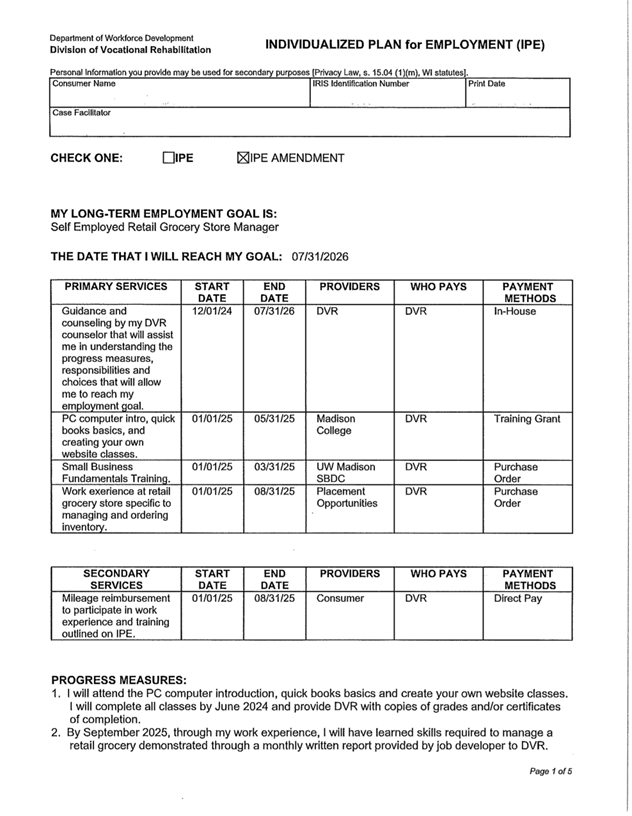
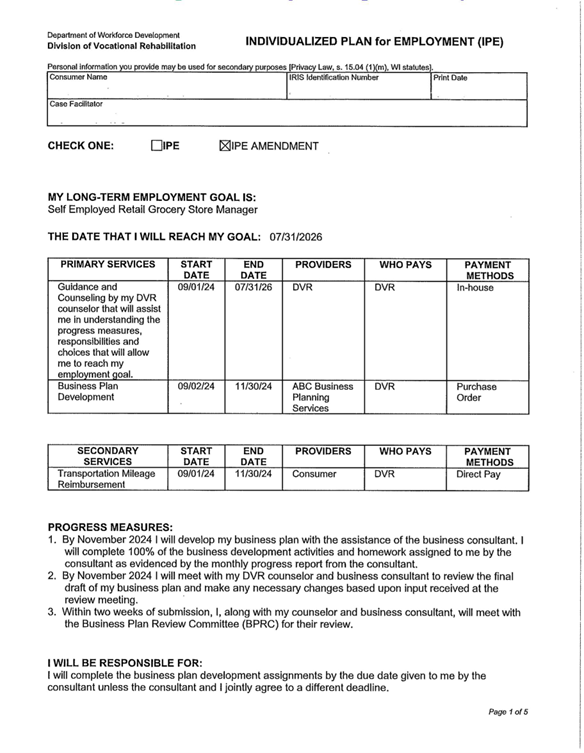
Supported Self Employment Toolkit, Step 5 – Develop the Individualized Plan for Employment (IPE) to Address Feasibility Action Items: Her IPE is created at this point. It included services from her business consultant to help her reconfigure her business model to make more money as well as business planning services. The business model was reconfigured prior to her business plan being started. The new model consisted of different packages ranging in pricing, allowing customers to have upgrades added in that would bring in more money for Bonnie and add a minimal amount of time to each detail.
Supported Self Employment Toolkit, Step 6 – Develop Business Plan and Amend the IPE to Include Business Plan Development Services: After Bonnie completed the feasibility action items required by her VRC, the Business Planning Team started to work with business consultant A, on a business plan following DVR's technical specification.
Supported Self Employment Toolkit, Step 7 – Review Business Plan: When the business plan was complete, a business plan review was scheduled. All members of the Business Planning Team attended, as well as business consultant A. The business plan review committee asked questions based on their review of her plan.
Bonnie received a letter with action items she must complete from the committee. She needs to update her startup needs list, update her operating costs to include different sizes of cars and how much smaller versus a larger car would cost, and provide more information on her upgrades. The committee also made sure that Bonnie and her VRC connected with her MCO case manager to confirm that the MCO has agreed to the recommended support of job coaching after her DVR case is closed. The VRC also ensured that they gave all required information to the MCO case manager so that they could submit a RAD (Resource Allocation Decision). Once the RAD process is complete, the MCO has agreed to take over job coaching when it is time to transition. If the RAD process determines that other kinds of supports are needed. Bonnie, her MCO case manager, and her VRC should meet to discuss support needs.
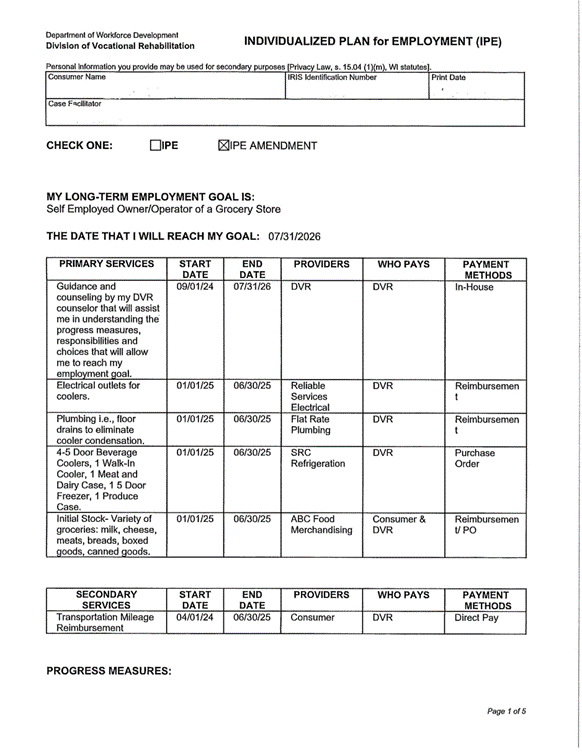
Supported Self Employment Toolkit Step 8 – Open the Business: Bonnie, with the help of her entire Business Planning Team, completed the action items required by the business plan review committee. They were submitted to the business plan committee who approved her business plan and requested startup items. Her IPE was updated, and DVR purchased the approved startup items from her business plan. Her VRC recommended that she connect with SCORE so that she has a business mentor to consult with as her business grows and operates.
Supported Self Employment Toolkit Step 9 – Successfully Close DVR Case: Bonnie's Business Planning Team met after all the items were purchased to finalize Bonnie's transition from DVR to long term supports. Her MCO will provide ongoing job coaching. Brian and Eleanor will continue to provide the support they committed to so long as Bonnie's business is open and operating. After the meeting, Bonnie opened her business.
She was able to sell many upgrades, and her business was profitable. Her VRC collected a profit and loss statement at every 30-day contract. After four (4)months, Bonnie had three (3) months of making minimum wage or more. A final transition meeting was held with Bonnie's Business Planning Team. The VRC paid the agency that supplied her job coach for the transition report at the time of transition. The VRC monitored Bonnie's progress for another 90 days and was able to close her case successfully.
DWD Contact Information
201 E. Washington Ave
P.O. Box 7946
Madison, WI 53707
(608) 266-3131
Sign up for DWD news and updates


A proud partner of the  network