Skip main navigation

Outdated or Unsupported Browser Detected
DWD's website uses the latest technology. This makes our site faster and easier to use across all devices. Unfortunatley, your browser is out of date and is not supported. An update is not required, but it is strongly recommended to improve your browsing experience. To update Internet Explorer to Microsoft Edge visit their website.

Hearing Aid Policy and Procedures

Effective May 2026

This policy describes the hearing aid process, key considerations for DVR case facilitators, payment rate determination, and related services such as maintenance and repairs.

When purchasing hearing aids, careful evaluation is essential. The DVR case facilitator must review all ongoing costs and long-term responsibilities with the consumer, including potential cost increases, follow-up appointments, routine maintenance, batteries, repairs, and future replacement needs.

Note: For cochlear implants please follows the Provision of Medical Restoration Services Traditional & Non-Traditional policy.

DVR staff are encouraged to consult with Advanced VRCs, VR Supervisors and Directors, local WDA SenseAbility representatives, and the SenseAbility team (DVRSenseAbility@dwd.wisconsin.gov) for guidance as needed.

Expand All | Collapse All

If at any point in the vocational rehabilitation process a consumer shows signs of or mentions hearing loss, the DVR case facilitator should ask questions to assess the consumer’s functional hearing in relation to their current work environment, IPE goal, and participating in DVR services.

During Referral and Application status:

  • Respond to specific questions about hearing aids during the application process.
  • Inform the consumer that eligibility must be determined before developing an IPE or authorizing services.
  • Remind the consumer that DVR assistance with hearing aids is not guaranteed and must be determined necessary and appropriate based on individual circumstances.

During IPE Development/Initiation of IPE Services:

Confirm that hearing aid/s and related services are necessary and appropriate to achieve the IPE goal.

  • If employed:
    • Identify job, employer, and work setting.
    • Acquire wage documentation from consumer to verify employment.
      • If self-employed, follow existing business policy.
    • Discuss job requirements and tasks impacted by hearing loss.
    • Determine whether performance issues are present (documentation from employer not required).
    • Determine if hearing aid needs to be compatible with employer technology or other devices.
    • Share new information with VRC if vocational counseling is needed.
  • If not employed:
    • Identify employment goal.
    • Identify anticipated work environment and tasks that may be impacted by hearing loss.
  • If consumer has hearing aids:
    • Determine whether an existing device may need:
      • A conformity evaluation (to assess proper functioning, needed adjustments, cleaning, maintenance, repairs, or replacement).
    • DVR may authorize for an audiologist to perform a conformity evaluation or electronic update if appropriate; comparable benefit (e.g. insurance) may cover this.
    • Identify any existing connection with an audiologist or medical professional (Audiologist, Physician, Hearing Instrument Dealer (HIS), VA).
    • Obtain copy of audiogram.
      • The audiologist may require a more recent audiogram than what is currently available or to complete their own.
  • Assess need for additional workplace accommodations:
    • Assistive technology (e.g., noise-canceling headphones, captioned telephone).
    • Workplace assessment (e.g., quieter space, reduced distractions).
  • Remind consumer that DVR policy requires services to be provided by a licensed audiologist.

If it is determined that hearing aid/s (new or replacement) and/or related services may be necessary to achieve the IPE goal, proceed with the next steps.

The hearing evaluation process includes several steps; consumers with a history of hearing loss and prior hearing aid/s use may require less information.

Comparable Benefits

Comparable benefits (e.g., Medical Assistance, private insurance) must be identified before purchasing services, including hearing aid evaluations, when doing so will not cause significant delays (e.g., job loss).

Hearing evaluations may or may not be covered by insurance; if the consumer has insurance, they should determine coverage for hearing evaluation with audiogram (if updated one is needed) and hearing aid recommendations.

  • DVR staff will collect documentation of insurance coverage (copay, deductible, limitations) from consumer or provider.
    • Examples include billing details from audiologist, email from insurance company, or statement of benefits explaining benefits coverage. Enter case note summarizing discussion and next steps.
  • DVR staff will attach the documentation of insurance coverage to the case file.
  • If the consumer has insurance but cannot meet the deductible, DVR may assist on a case-by-case basis (refer to the scenarios in Determine Pricing and Quotes Including Comparable Benefits section. Also, consult with local management and SenseAbility as needed).
  • When insurance is used, two additional price quotes for the same hearing aid/s are required (for a total of three quotes and internet search is permittable). Quotes must be attached to case. Quotes are not needed if the hearing aids are provided at the Medical Assistance (MA) rate or invoice + 15% (plus Medicaid rate for the dispensing fee).

Hearing Evaluation Process

If the consumer has not had a recent evaluation, refer to a licensed audiologist for a hearing evaluation and/or hearing aid evaluation (these may be done separately).

  • The audiologist may require a more recent audiogram than what is currently available or to complete their own.
  • Send Audiologist Handout/Letter with Purchase Order.

Licensed Audiologist

DVR must use a licensed audiologist—not a certified hearing aid dispenser or unlicensed vendor—to evaluate a consumer’s hearing needs. Refer to Fed Reg 801.109 for more information.

  • The audiologist must be licensed by the State of Wisconsin and may hold:
    • Doctorate in Audiology (Au.D.), or
    • Master’s degree if grandfathered to meet state licensure requirements.
  • A licensed audiologist provides comprehensive, specialized services, including:
    • Audiological evaluations (hearing sensitivity, speech understanding, middle ear, inner ear, and auditory nerve function).
    • Design, selection, fitting, and verification of hearing instruments and assistive listening devices.
    • Rehabilitation therapy (e.g., hearing strategies, speech reading/lip reading, sign language).
    • Recommendations for over-the-counter (OTC) hearing aids or amplifiers (if required).
    • Services are provided on an individualized basis and must be related to the consumer’s disability and employment goal.

The hearing aid evaluation should include:

  • A recommendation for specific hearing aid(s).
  • Clinical rationale, including:
    • Type, degree, etiology, and prognosis of hearing loss
    • Listening needs assessment
    • Fitting plan
  • An itemized cost breakdown, including:
    • Hearing aid(s)
    • Dispensing fee
    • Related items (e.g., earmolds, FM systems, Bluetooth, loop systems, fitting fees)
    • Ask if audiologist will take Medical Assistance (MA) rate or invoice + 15% (plus Medicaid rate for the dispensing fee) or insurance and what those estimates would be.

Evaluation results and recommendations:

  • If permanent hearing loss is identified, hearing aids may be recommended for one or both ears.
  • The audiologist explains hearing test results and expected benefits of hearing aids.
  • Hearing aid styles, features, and technology levels are typically discussed at a follow-up appointment.
  • Based on the evaluation, the audiologist may recommend follow-up with another specialist for further assessment (e.g., ENT, general practitioner, surgeon, etc.).

Selection and fitting:

  • Once the hearing aid type is selected, ear impressions may be taken for custom devices or earmolds.
  • Hearing aids are ordered from the manufacturer and programmed to meet the consumer’s needs.
  • The process may take several weeks and require multiple appointments.

Note: Refer to section 7. Resources and Definitions for information on how to read an audiogram including an example of a standard and functional audiogram.

If hearing aid/s are recommended, proceed with next steps.

Prices and Quotes

DVR’s maximum contribution is the least-cost option or lowest competitive quote obtained. Comparable Benefits (e.g. insurance) may or may not be less costly than MA Maximum Allowable Fee Schedule rate or invoice + 15% (plus Medicaid rate for dispensing fee). If an exception to this policy is needed or there is a concern about a delay in service, consult with your supervisor.

  • Determine least-cost of the following options:
  • If provider accepts either the Medical Assistance (MA) rate or invoice + 15% (plus Medicaid rate for the dispensing fee):
    • Quotes not required.
    • Verify rate is accurate and current (it may be necessary to check with the provider for any Medicaid-allowed price adjustments).
  • If provider does not accept Medical Assistance (MA) rate or invoice + 15% (plus Medicaid rate for the dispensing fee), then quotes are required:
    • Obtain three quotes for the same hearing aid/s (internet search permitted).
    • Consider if the providers providing the quotes will comply with DVR billing policy.
    • Label and attach to case file.
  • If the consumer has private insurance:
    • Even if provider accepts MA rate or invoice + 15 %, insurance should still be applied when applicable.
    • Private insurance is billed first, then a PO is used to pay the remaining amount.
    • PO should include expected insurance coverage for each line of PO.
    • If there is difficulty getting an amount from the insurance company, the PO can identify the estimated insurance percentage or amount.
      • Update PO once actual insurance payment is known.
    • Even when using insurance, two additional quotes are required (internet search is permittable) unless the provider accepts Medical Assistance (MA) rate or invoice + 15% (plus Medicaid rate for the dispensing fee). Quotes must be attached in the case.
    • Use of insurance and an associated provider may be beneficial for follow-up and consistency and should be considered when making provider determination.
  • Consumers may choose a higher-cost option but must pay the cost difference.
  • Ensure providers that are providing quotes will comply with DVR billing policy.
  • Confirm that warranty and repair terms are included.
  • Contact provider if discrepancies exist.

Comparable Benefits

Hearing aids may not be covered by insurance; if the consumer has insurance, they should determine coverage for hearing evaluation, audiogram, and hearing aids/devices.

  • DVR staff will collect documentation of insurance coverage (copay, deductible, limitations).
    • Examples include billing details from audiologist, email from insurance company, or statement of benefits explaining benefits coverage. Enter case note summarizing discussion and next steps.
  • Attach the documentation of insurance coverage to the case file.
  • If the consumer has insurance but cannot meet the deductible, DVR may assist on a case-by-case basis (refer to the scenarios below and consult and local management and SenseAbility as needed).
  • When insurance is used, two additional price quotes for the same hearing aid/s are required (for a total of three quotes and internet search is permittable), unless the hearing aids are provided at the Medical Assistance (MA) rate or invoice + 15% cost, plus Medicaid rate for the dispensing fee. Quotes must be attached to case.

The scenarios below provide examples of how to apply comparable benefits (insurance coverage) when determining the least-cost option in hearing aid funding decisions.

Scenario 1:

  • The consumer has insurance coverage for hearing aids but must pay a premium or copay (e.g., $500) before coverage applies.
  • DVR may reimburse the premium or copay if this allows insurance to cover the remaining costs.
  • DVR may request a cost breakdown from the audiologist and compare the insurance option to the Medical Assistance (MA) rate or invoice + 15% (plus Medicaid rate for the dispensing fee).
  • The least-cost option should be selected.

Scenario 2:

  • The consumer has insurance coverage for hearing aids.
  • The audiologist bills usual and customary charges to the insurance provider first and the remaining to DVR.
  • Insurance provider requires the consumer to pay the full cost upfront (e.g., $5100) and submit a paid-in-full receipt for insurance reimbursement.
  • The insurance reimburses only a portion (e.g., $1100), leaving the consumer with a significant out-of-pocket cost (e.g., $4000).
  • An alternative is to forego insurance and use the DVR-approved Medical Assistance (MA) rate or invoice + 15% (plus Medicaid rate for the dispensing fee) (e.g., $3318.22).
  • Although a comparable benefit exists, the DVR-approved rate is the least-cost option and should be pursued.

Other potential comparable benefits include:

Once pricing has been determined, quotes are attached to the case (as appropriate), and the hearing aid/s and related services have been added to the IPE, proceed with next steps.

  • Enter an authorization case note (Fiscal 5) and attach required quotes (if applicable).
  • Use the appropriate hearing aid service codes in the Fiscal Account Codes Document and in the chart below.
  • A copy of the Forward Health Dispensing Fee Guidance can be included with the DVR Purchase Order.
Authorization and Coding Hearing Aids Examples and Included Items
Title Examples and Included Items Code Object/Sub-Object Codes
Hearing Evaluations Hearing Assessments, Audiology Exams etc. 021 Service: 8910000 (5712)
Hearing Aids Restoration Hearing Aids, Hearing Aid Related Equipment 036 Supply: 8800000 (5700-72)
Hearing Aid Dispensing Fee Includes:
  • Initial office visit
  • Ear mold impression
  • Proper fitting of the hearing device, plus up to 5 post-fittings as necessary for hearing device orientation and adjustments (including performance checks)
  • Real Ear Measurements (REM) verification
  • Any necessary service to maintain proper function of the hearing device
  • A 12-month service guarantee
036 Service: 8910000 (5712)
Hearing Devices Rehabilitation Technology Devices (FM Systems, Bluetooth, loop systems, etc.)

Note: If the rehabilitation technology is built directly into the hearing aid, code as 036.
033 Supply: 8800000 (5700-72)

To determine WI Medical Assistance Maximum Allowable Rates for hearing aids and related services, use the following resources:

The following are the Medical Assistance maximum allowable rates for hearing aid dispensing fees, as of February 2026:

  • V5110 Dispensing fee, bilateral: $646.06
  • V5160 Dispensing fee, binaural: $646.06
  • V5200 Dispensing fee, CROS: $358.93
  • V5240 Dispensing fee, BICROS: $646.06
  • V5241 Dispensing fee, monaural hearing aid: $358.93

Receiving and Case Documentation

  • Verify with the consumer that all goods and services have been received.
  • Confirm devices are functioning properly.
  • Provide troubleshooting guidance as needed.
  • Discuss a plan for maintenance, repairs, and battery replacement, including payment responsibility and planning for future costs (see sections 5. Maintenance, Repairs, and Warranties and 6. Planning for Future Costs for more information).
    • Provide funding/resource information.
  • Document these discussions in the case and receive on the PO.

Daily care and maintenance

  • Hearing aids require daily cleaning to remove earwax, which can damage internal components.
  • Exposure to water, humidity, condensation, or perspiration can cause significant damage.
  • Hearing aids must be dried daily, preferably using a dry box.

Storage and protection

  • Store hearing aids in a consistent, safe location when not in use.
  • Keep devices out of reach of children and pets, which may be attracted to them.

Batteries and upkeep

  • Hearing aids typically include a starter set of batteries; consumers are responsible for purchasing replacements.
  • Consumers should consult their audiologist regarding battery options.
  • Hearing aids may require repairs or programming updates, which can often resolve performance issues.
  • Existing hearing aids should be brought to appointments to assess repair or update options.

Replacement

  • DVR may replace hearing aids when necessary for employment.
  • Replacement decisions should consider functional impact and work environment to support job independence.

Warranty and lifespan

  • Most hearing aids include a one-year manufacturer warranty covering loss, damage, and repairs.
  • Extended two- or three-year warranties may be available through audiologists.
  • The average hearing aid lifespan is six years.
  • DVR may assist with extended warranty costs on a case-by-case basis or negotiate cost-sharing with the consumer.

Following the purchase of hearings aids with DVR's assistance, consumers should identify strategies for funding future hearing aids, including resources to assist with personal savings planning.

Note: DVR staff are encouraged to consult with Advanced VRCs, VR Supervisors and Directors, local WDA SenseAbility representatives, or the SenseAbility team (DVRSenseAbility@dwd.wisconsin.gov) for guidance.

National Institute on Deafness and other Communication Orders (NIH)

Hearing Aid Process Flow
Visual/PDF Flow Chart

How to read an audiogram

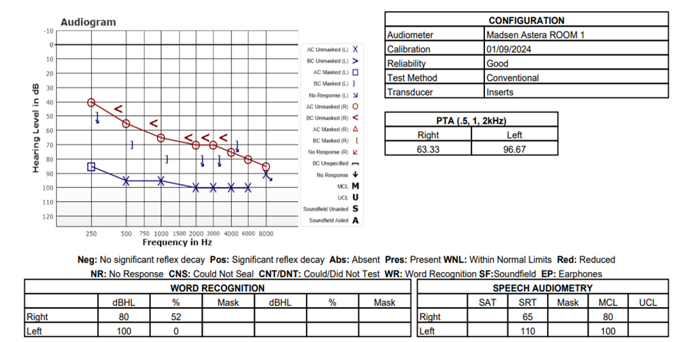
  • An audiogram shows how well sounds are heard in terms of frequency (high-pitched versus low pitched sounds) and intensity (loudness).
  • Frequency is measured in Hertz (Hz) and ranges from low to high pitch (left to right).
    • Each vertical line represents a different frequency (250-8000 Hz).
  • Intensity is measured in decibels (dB) (loud or soft).
    • Each horizontal line represents intensity level, soft at the top and loud at the bottom.
  • Each ear is tested separately because hearing ability can differ between ears.
    • Right ear is graphed as a circle or triangle.
    • Left ear is graphed as an X or square.
  • Sounds above the connected lines represent tones the individual cannot hear.
  • Normal hearing for adults is 0-25 dB.

Audiogram Examples

Audiologist's Report/Audiogram Examples

Functional Audiogram

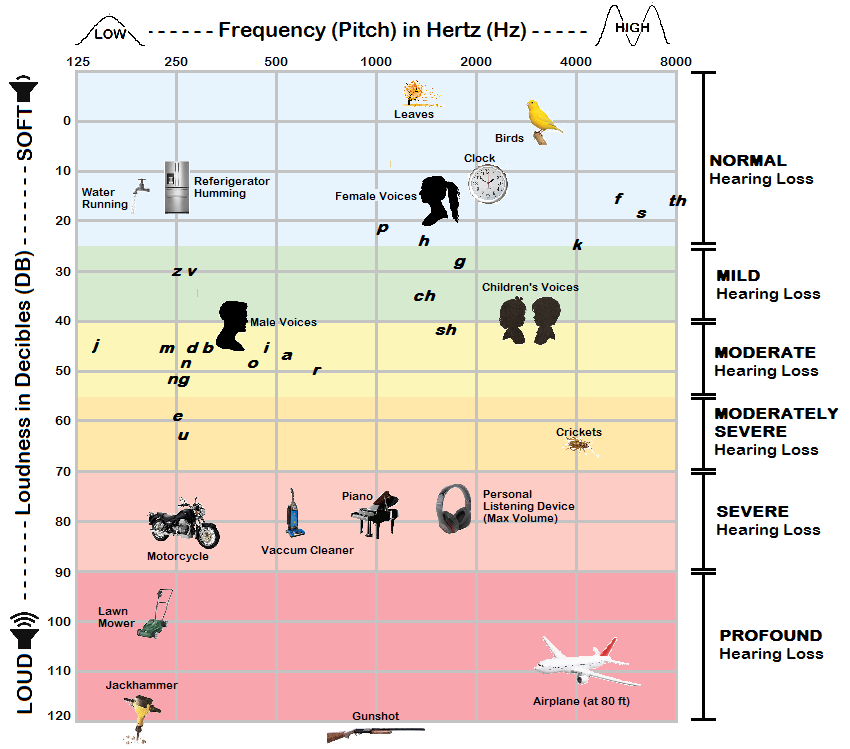
  • A functional audiogram shows how hearing loss at a certain decibel or frequency might impact work.
  • Speech Banana: A term used to describe the area where all phonemes, or sounds of human speech, appear on an audiogram. Does your consumer have difficulty understanding human speech? Look at the audiogram below and identify the parts of sound they are not detecting.

Functional Audiogram

American Speech-Language-Hearing Association (ASHA):
The professional organization which grants certification for Audiologists and provides resources around hearing and hearing loss

Amplifier:
The component of the hearing aid that boosts the volume of sound.

Audiogram:
The chart that provides a visual representation of your hearing exam results. The vertical axis measures decibels (volume) and the horizontal axis measures frequencies (pitch). An audiologist documents the lowest decibel level you can hear at each frequency. The line on an audiogram identifies the level of hearing loss for each ear. There may also be a field for speech recognition threshold (SRT) which gives a percentage for the amount of speech the person is able to decipher.

Behind the Ear (BTE) Hearing Aids:
Hearing aid with the majority of its parts contained in a case placed behind the ear and attached to an earmold by a clear plastic tube. Mini-BTE hearing aids are also available.

Bilateral Hearing Loss:
Hearing loss in both ears, which could be symmetrical (the same degree of loss in both ears) or asymmetrical (different levels of loss in each ear).

Bluetooth Technology:
Enables the hearing aid to communicate wirelessly with several devices, including mobile phones, computers, MP3 players, and other compatible products.

Cerumen:
Medical term for ear wax.

Conductive Hearing Loss:
Hearing loss occurring in the outer or middle ear that limits the ability of sound to reach the inner ear. This type of loss benefits the most from amplification.

Decibel (dB):
The unit of measure for sound level or intensity. Normal conversation registers at approximately 60 decibels, and long-term exposure to any sound more than 80 decibels could cause irreversible hearing loss. Since the scale is logarithmic, an increase of 6-10 decibels doubles the volume of the sound. See diagram on page 10 for an example.

Degree of Hearing Loss:
Hearing loss is generally classified as:

  • Mild Hearing Loss: 26-40 dB
  • Moderate Hearing Loss: 41-55 dB
  • Moderate to Severe: 56 - 70 dB
  • Severe Hearing Loss: 71 - 90 dB

Digital Signal Processor:
A special microprocessor inside of a hearing aid that manipulates and enhances sound.

Directional Microphones:
Microphones that can focus in on sound coming from a specific location while minimizing background noise.

Earmold:
A piece of plastic, acrylic, or other pliable material that is shaped to the contours of an individual’s ear, used for the fitting of hearing aids.

Frequency:
Represents pitch as measured in hertz. Picture moving up the keys on a piano, from left to right (low-frequency/pitch to high-frequency/pitch). See diagram on page 10 for an example.

FM/DM System:
A device (not a hearing aid) used to amplify sounds and transmit audio from a speaker (transmitter with microphone) to a listener (receiver with earbuds, headphones, or neckloop).

Hearing Aid Definitions
Hearing Aid Terms Defined

Hearing Aid Style:
The type of hearing aid defined by its size and position relative to the ear. Common styles include behind-the-ear, receiver in-the-ear, and in-the-canal.

Hearing Loss Association of America (HLAA):
Informative resource on hearing loss and related topics.

High-frequency Hearing Loss:
The most common type of hearing loss. People with high-frequency hearing loss have the most difficulty hearing higher frequency sounds, like the sounds of speech.

In-the-canal (ITC) Hearing Aids:
Hearing aid with parts enclosed in a case that fits inside of the ear canal. Completely-in-the-canal (CIC) hearing aids are also available that are near invisible when worn.

In-the-ear (ITE) Hearing Aids:
Hearing aid with parts enclosed in a case that fits in the outer part of the ear.

Loop System:
A listening system consisting of a loop of wire placed around the perimeter of a designated area (room) and connected to an existing PA system for that space to transmit sound directly to hearing aids that have a telecoil program setting. It can also transmit to handheld receiver devices with headphones for individuals who do not have a telecoil equipped hearing aid. Used in churches, some libraries, and theaters.

Microphone:
The hearing aid component that picks up sound in the environment and converts the sound waves into an electrical signal.

Mixed Hearing Loss:
Hearing loss that is a combination of conductive and sensorineural losses.

Noise Reduction:
Functionality that assists the hearing aid to differentiate speech sounds from background noise, which results in the augmentation of speech and the inhibition of distracting noise.

Over-the-Counter (OTC) Hearing Aids:
Hearing aids that are available without a prescription. Intended for people with mild to moderate hearing losses only.

Receiver In-the-Ear and In-the-Canal (RIE/RIC) Hearing Aids:
Hearing aids which include a small component outside of the ear to capture incoming sounds which connects to a small speaker placed inside the ear canal.

Sensorineural Hearing Loss:
A type of hearing loss that occurs when there is damage to the nerve cells of the inner ear. This is the most common type of permanent hearing loss, triggered by being exposed to loud noise, the aging process, genetics, or other health issues. A person may “hear” sounds but had difficulty or is not able to understand speech.

Speaker:
The hearing aid component that delivers the enhanced sound to the ear.

Telecoils:
A coil placed inside of a hearing aid that allows it to connect to wireless signals originating from telephones, assistive listening devices, and hearing loops installed in public venues.

Threshold of Hearing:
The lowest decibel level that can be detected at each frequency.

Tinnitus:
A prolonged ringing or buzzing in the ears when no external sound is present. Usually a sign of hearing damage or loss.

Wireless Antenna:
Available in specific hearing aids, enabling wireless connectivity to compatible gadgets such as smartphones and music players.

Unilateral Hearing Loss:
Hearing loss which is only in one ear.

Variable Programming:
Hearing aid programming that enables the individual to adjust sound settings depending on the environment (e.g. at home versus in a chaotic restaurant).